The Future of Employee Recognition

Introduction
 Recognition programs play a vital role in shaping employee perceptions and workplace experiences. As AI, hyper-personalization and predictive analytics transform the way people work across industries, these technologies also have the potential to deliver significant improvements in the day-to-day employee recognition experiences. In this eBook, we explore the future of employee recognition from three perspectives:
Strategy: What are the goals and challenges that exist today for improving employee recognition programs and experiences?
Technology: What use cases exist for leveraging currently available technologies to address today’s goals and challenges?
Risks: What are the technology risks, adoption and governance issues that must be addressed for safe, secure and successful deployment?
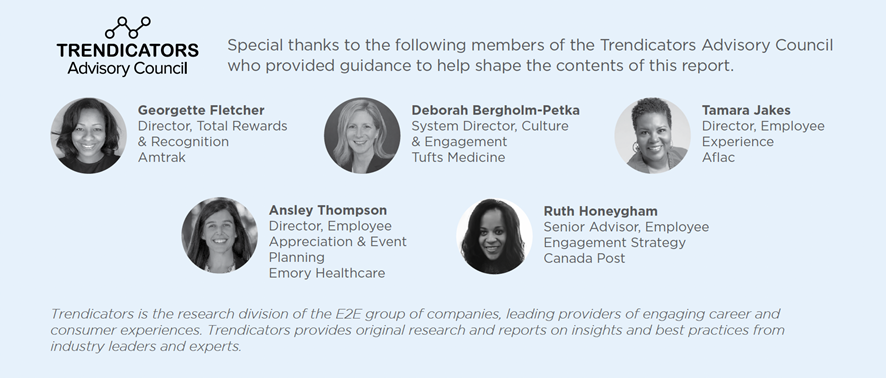
These topics were discussed during a recent roundtable with members of the Trendicators Advisory Council, with one key consideration in mind:
AI must support, rather than replace, human interaction in employee recognition to maintain authenticity, empathy and emotional connection, as algorithmically generated praise often feels impersonal or insincere.
The session was moderated by Jeff Gelinas, President of Employee and Consumer Engagement at Engage2Excel, Dr. Charles Scherbaum, Engage2Excel’s Chief Analytics Officer and professor of psychology at Baruch College, City University of New York and Andrea Shepherd, Chief Customer Officer at Engage2Excel.
Download
 hbspt.cta.load(123973, '050afb7d-91ac-4a16-b7f6-083ca260677d', {"useNewLoader":"true","region":"na1"});
STRATEGY: Goals and Challenges for Improving Employee Recognition
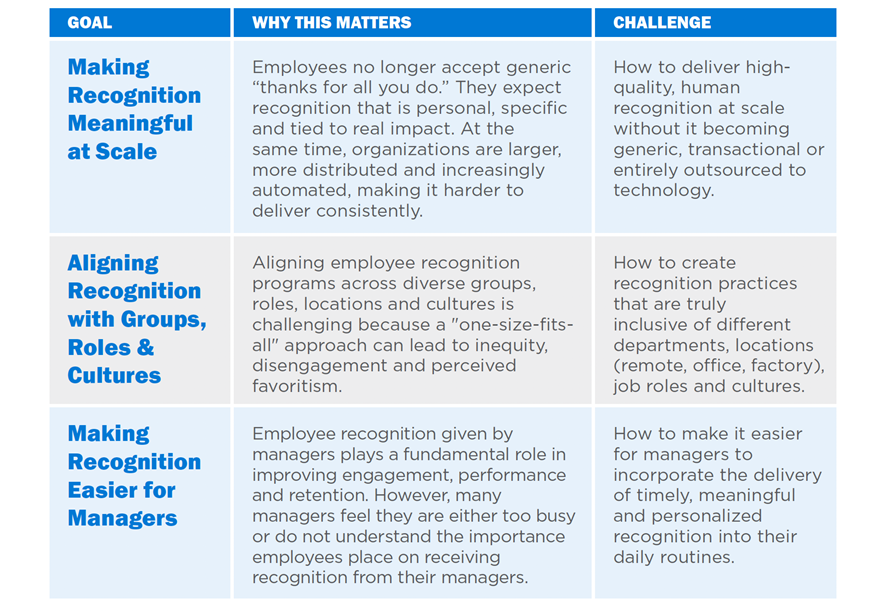
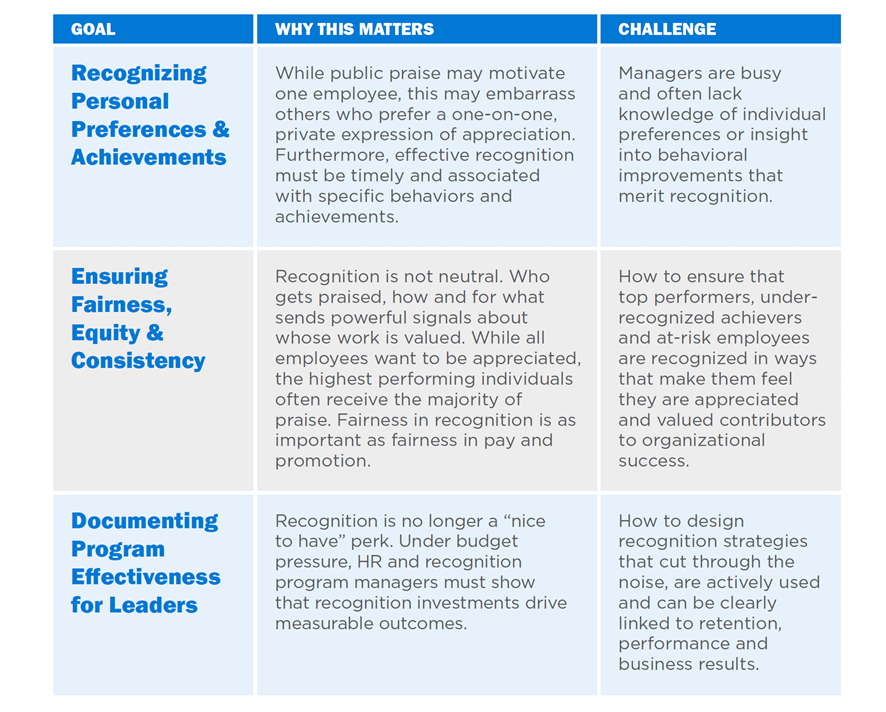
Employee recognition sits at the intersection of engagement, performance and culture. While today’s technologies offer great promise for creating more meaningful recognition experiences, prioritizing strategic objectives is the first step for ensuring that transformation initiatives drive tangible business value. In this section, we review six goals and challenges that HR leaders can address to improve the effectiveness of employee recognition and rewards programs.
Download
hbspt.cta.load(123973, '050afb7d-91ac-4a16-b7f6-083ca260677d', {"useNewLoader":"true","region":"na1"});
Recognition Strategy vs. Platform
When prioritizing use cases for improving employee recognition experiences and outcomes, HR leaders need to distinguish between their recognition strategy and the third-party SaaS platforms that support it. The platform is an enabler, not the program itself. Clarity on this separation helps HR retain ownership of vision, values, governance and success metrics, while holding vendors accountable for configuration, data practices and technical performance that align with the organization’s culture and compliance requirements.
Download
hbspt.cta.load(123973, '050afb7d-91ac-4a16-b7f6-083ca260677d', {"useNewLoader":"true","region":"na1"});
TECHNOLOGY: Use Cases for Addressing Current Recognition Challenges
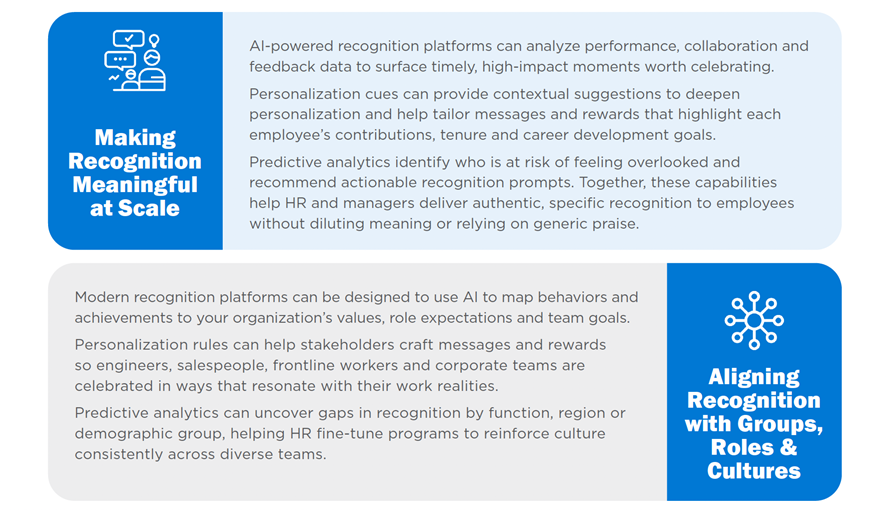
Agentic AI, along with personalization and predictive analytics, can improve employee recognition programs by enabling hyper-personalization, increasing the timeliness, frequency and authenticity of recognition and reducing bias. When integrated with HRIS and other systems, these technologies can analyze performance and other data to trigger in-the-moment recognition and rewards recommendations to help leaders, managers and employees create more meaningful recognition experiences.
The use cases in this section are not a checklist for immediate implementation, but a window into what’s quickly becoming possible. They’re designed to provide HR leaders with a look into the future of employee recognition and how the tools currently available will realistically evolve recognition programs and expectations over the next few years.
Please refer to the Glossary on page 10 for the definition of key terms used in this report.
Download
hbspt.cta.load(123973, '050afb7d-91ac-4a16-b7f6-083ca260677d', {"useNewLoader":"true","region":"na1"});

Download
hbspt.cta.load(123973, '050afb7d-91ac-4a16-b7f6-083ca260677d', {"useNewLoader":"true","region":"na1"});
RISK: Technology Risks, Adoption & Governance Issues
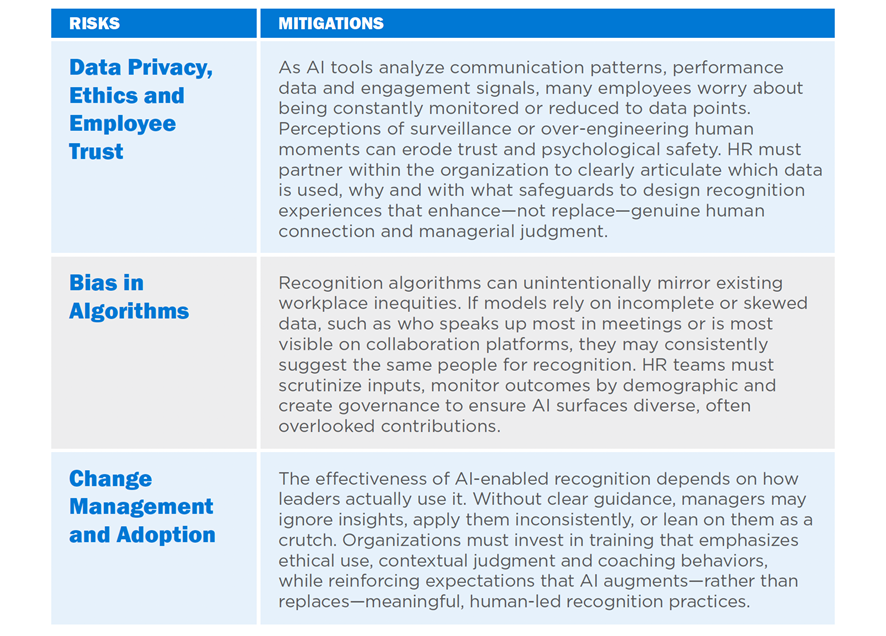
AI-powered recognition promises powerful gains, but it also introduces new risks HR leaders cannot ignore. From data privacy concerns to algorithmic bias and change fatigue, missteps can undermine employee trust and damage culture. This section explores the technology challenges and considerations that accompany innovation and how to navigate them thoughtfully to unlock sustainable value.
Download
hbspt.cta.load(123973, '050afb7d-91ac-4a16-b7f6-083ca260677d', {"useNewLoader":"true","region":"na1"});

Access to Enterprise Data: The extent to which the use cases discussed on pages 5 and 6 will materialize depends on the levels of access to enterprise data granted to recognition partners incorporating agentic or generative AI into their platforms. Absent such access, progress toward achieving the use case goals can be achieved, albeit to a lesser degree, by relying on information and data generated within the recognition platform.
Download
hbspt.cta.load(123973, '050afb7d-91ac-4a16-b7f6-083ca260677d', {"useNewLoader":"true","region":"na1"});
BACKGROUND: Key Takeaways & Additional Information
The Trendicators research division of the E2E group of companies conducts roundtable discussions with members of the Trendicators Advisory Council to inform our research and best-practice reports. For this report, we spoke with council members responsible for employee recognition at Amtrak, Tufts Medicine, Aflac, Emory Healthcare and Canada Post to understand their priorities and challenges in improving program effectiveness.
Top priorities identified in the roundtable discussions included:
- Providing more granular insights for leaders on program effectiveness and areas for improvement to increase business value
- Making it easier for managers and peers to give authentic, meaningful and timely recognition
- Improving the personal relevance and appeal of recognition and rewards by better understanding individual preferences, behaviors, achievements, roles, responsibilities and aspirations
- Using analytics to more closely align recognition programs with business objectives related to engagement, performance and retention
These priorities, along with extensive research by our solution development team and guidance from Dr. Charles Scherbaum, Chief Analytics Officer at Engage2Excel Group, shaped the goals, use cases and risk analysis presented in this report.
This eBook illustrates what’s possible today when organizations align their strategic goals for improving employee recognition with modern technologies. The examples provided are potential applications, not a technical blueprint or implementation guide.
THE CURRENT STATE OF AI ADOPTION
AI in Employee Recognition: Like many sectors, employee recognition is in the early stages of AI adoption. Leading platforms offer AI-enabled support for message coaching, analytics and reporting. Most platforms today still rely on some combination of rule-based automation, structured database reporting, and API-driven integrations to manage workflows and analytics. Core technologies include robotic process automation, traditional BI dashboards, workflow engines, and SQL-based analytics, which require manual programming for automation and insights.
Download
hbspt.cta.load(123973, '050afb7d-91ac-4a16-b7f6-083ca260677d', {"useNewLoader":"true","region":"na1"});
KEY TAKEAWAYS & ADDITIONAL INFORMATION
AI Adoption in HR: According to early 2026 research by the Society for Human Resource Management (SHRM), AI adoption in HR has shifted from experimentation to active, yet cautious, integration, with 43% of organizations now leveraging AI for HR tasks, up from 26% in 2024. While recruitment (specifically generating job descriptions and screening resumes) is the dominant use case, only 17% of HR professionals consider their AI implementation “highly successful”. The current focus is on combining AI with human intelligence, with 50% of HR responsibilities expected to be AI-augmented or automated.
Leading Sectors in the Adoption of Agentic AI: According to McKinsey & Company, the financial services, retail, healthcare, manufacturing and logistics sectors are leading the adoption of Agentic AI, integrating autonomous, multi-step workflows into enterprise systems to boost efficiency. Key applications include automated fraud detection, personalized retail experiences, predictive maintenance and supply chain optimization. These sectors are leveraging AI to reduce transaction costs and improve decision-making.
GLOSSARY
The following definitions are provided to clarify the key technologies referenced throughout this publication.
Generative AI is a type of artificial intelligence that creates new content, such as text, images, video, audio or code by learning patterns from training data.
Agentic AI refers to advanced AI systems capable of autonomous action, including planning, decision-making and executing multi-step tasks with minimal human oversight, often through AI agents that interact with environments or tools.
Hyper-Personalization is the use of AI to deliver highly customized experiences, recommendations or services tailored to individual preferences, behaviors and needs at scale, enhancing engagement and loyalty.
Predictive Analytics involves AI techniques to analyze historical and real-time data, forecasting future outcomes, trends or behaviors to inform decisions across different parts of an organization.
Download
hbspt.cta.load(123973, '050afb7d-91ac-4a16-b7f6-083ca260677d', {"useNewLoader":"true","region":"na1"});